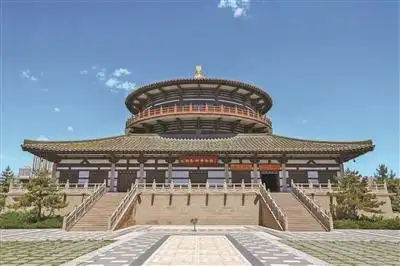
The exterior of the Northern Dynasties Art Museum echoes the architectural style of a Northern Wei Mingtang hall.
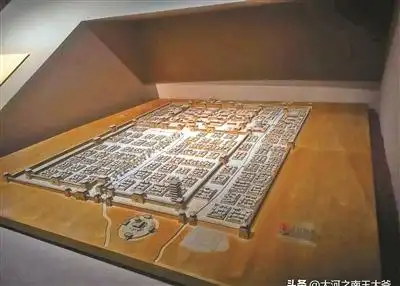
A model of Northern Wei Pingcheng at the Datong Museum.
Editor’s Note:Thanks to a two-hour high-speed rail loop, a comfortable visitor experience, and deep cultural roots, Datong has quietly become one of Beijingers’ favorite weekend “backyard” escapes. An ancient capital distilled over a millennium, Datong has weathered layer upon layer of history — a prominent commandery under the Zhao and Qin, the imperial capital of the Northern Wei, the western capital under the Liao and Jin, and a heavyweight military bastion through the Ming and Qing. Starting today, we launch a special series on Datong’s history and culture. Through the lenses of urban construction, surviving relics, and cultural landscapes, we will unlock the city’s thousand-year past. Our opening installment zooms in on the capital construction system of Northern Wei Pingcheng. From city layout and imperial architecture to ritual remains, it deciphers Datong’s historic foundations and the deep veins of its cultural lineage as a great northern capital.
Pingcheng is the earliest name for Datong, yet Pingcheng began as nothing more than a county seat — Pingcheng County — administered by Yanmen Commandery, a frontier commandery of the Han Dynasty, located in its eastern reaches. At the time the commandery seat — the central city of a commandery — was set in Shanwu County, what is today Youwei Town in Youyu County, Shuozhou. The establishment of Pingcheng as an administrative unit very likely dates back to the reign of King Wuling of Zhao during the late Warring States period. It was formally set as a county under the Qin, a system inherited by the Han.
Before the arrival of the Xianbei Tuoba clan, from Qin-Han through the Wei-Jin period, Pingcheng remained a county seat under Yanmen Commandery. The arrival of the Tuoba Xianbei handed Pingcheng a rare chance to leap forward in development, vaulting it from a frontier commandery’s subordinate county to the secondary capital of a kingdom, and then to the political heart of northern China and the eastern starting point of the fifth-century Silk Road. In the hands of the Tuoba Xianbei, Pingcheng became a model imperial capital of 1,500 years ago — a prototype whose influence would resonate far and wide.
From County Seat to Royal City: Why the Tuoba Xianbei Chose Pingcheng
During the late Western Jin and the opening of the Sixteen Kingdoms period, the Xianbei Tuoba chieftains were successively invested by the Western Jin court — then retreating to Chang’an — as Duke of Dai and then King of Dai for their support of Liu Kun, the Inspector of Bingzhou holed up in Jinyang, in his fight against the Han kingdom founded by the Xiongnu Liu Yuan. Pingcheng was selected as the Southern Capital of the Dai Kingdom, honored alongside Shengle and Yunzhong.
From a Central Plains perspective, Pingcheng — commanding the Desheng Pass (Yinma River Valley) — together with Youyu (ancient Shanwu), which commanded Shahukou (Cangtou River Valley), and Yanggao (ancient Gaoliu), which commanded the ancient Yanmen pass, were all fulcrums at the southern ends of strategic corridors leading into the northern grasslands. The strategic value of the three places was not far apart. For this reason, neither the Zhao, Qin, nor the Western and Eastern Han chose Pingcheng at the time as the regional center.
Through the eyes of the Xianbei Tuoba clan, however, it looked entirely different. For the Tuoba of the third and fourth centuries, Shengle (today’s Tuchengzi ancient city in Horinger County), the Yunzhong Plain (the heartland of the Tumd Plain where Hohhot now sits), Changchuan (within today’s Xinghe County, Ulanqab), and Niuchuan (within today’s Zhuozi County, Ulanqab) formed the core zone where the tribe lived and multiplied.
Pingcheng sits at the northern rim of the upper Sanggan River basin, pressed right up against those “three plains and one city” just mentioned, and it was linked to the Ulanqab area to the north via the Ru’rushui River (today’s Yinma River and Yuhe River). The ancient Canhe Slope battlefield, where the Northern Wei crushed the Later Yan, is wedged right between Datong and Ulanqab.
Pingcheng’s initial selection as the Southern Capital of the Dai Kingdom was a purely military strategic arrangement. In fact, the Dai Kingdom even set up a chain of fortress cities and military garrisons — headed by New Pingcheng (on today’s Huanghua Ridge in Shanyin) — along the Sanggan River south of Pingcheng, clearly designed to guard against any northward thrust by the Han-Zhao and Later Zhao powers.
Abandoning Yecheng: A Founding Emperor’s Choice of Capital
In 398 CE, the Northern Wei regime under Tuoba Gui swallowed up the Ji Province region of the Later Yan, thereby straddling Bing, Ji, and You provinces. Its territory now encompassed most of today’s central Inner Mongolia, the greater part of Shanxi, and much of the Beijing-Tianjin-Hebei region. As Murong De, the Later Yan Prince of Fanyang, abandoned Yecheng (within today’s Linzhang County, Hebei), Tuoba Gui took it with the momentum.
Before Tuoba Gui’s arrival, Yecheng had served successively as the capital or military-political nerve center for Yuan Shao, Cao Cao, Sima Ying, the Later Zhao, Ran Wei, and Former Yan. Even under the Former Qin and Later Yan, it was their eastern or southern strategic core. Yecheng was thus the first city captured by the Northern Wei that possessed the “sovereign aura” and “capital city planning” of a Central Plains dynasty. Tuoba Gui even went so far as to “tour the terraces and pavilions, gaze upon the palace city, and harbor thoughts of establishing a capital there” — seriously considering moving the capital to Yecheng.
Yet in the Northern Wei’s early years, Yecheng still had to contend with threats from the Shandong Peninsula (the Southern Yan established by Murong De) and the Eastern Jin forces south of the Yellow River. The Hebei Plain had just been subjugated, and Murong Bao of the Later Yan had fled back to Dragon City (today’s Chaoyang, Liaoning), still posing a tangible danger. The geopolitical environment was far from reassuring. Moreover, Yecheng lay far from the southern foothills of the Yin Mountains, where the Tuoba had held sway for nearly two centuries, with the Taihang Range cutting between them. Should anything go wrong, catastrophe could easily follow.
So, less than half a year after that inspection tour, Tuoba Gui formally chose Pingcheng — the heartland that generations of his people had cultivated and their key southern stronghold — as his capital. Pingcheng was not only close to the old Tuoba capital of Shengle, it also had the Taihang and Yan mountain ranges as natural geographical screens, making it territory that the remnants of the Later Yan and the Eastern Jin would find difficult to penetrate. Yecheng thus became a superb template for building an “imperial capital” at Pingcheng, serving as the crucial reference model for the city’s subsequent construction. In this way, Pingcheng ceased to be like Shengle — no longer the royal city of a separatist regime, but a true imperial capital possessing a dynastic, Son of Heaven aura.
Forging an Imperial Capital: The Northern Wei’s Construction of Pingcheng
In 398 CE (the first year of the Tianxing era), Tuoba Gui launched a series of fundamental state-building projects, a landmark event historians call the “Tianxing Institutional Creation.” TheBook of Wei, “Treatise on Food and Goods,” records: “At the beginning of the Tianxing period, the capital region was delimited: reaching Daijun in the east, Shanwu in the west, Yinguan in the south, and Canhe in the north — these were designated as the fields within the metropolitan domain. Beyond these, in the four directions and four corners, eight tribal marshals were appointed to supervise, encourage farming, measure harvest yields, and thereby rank performance.”
From this initial plan, we can already see that Pingcheng as the capital was no longer merely the single city of Pingcheng but also encompassed a rather extensive territory. This was Tuoba Gui’s delineation of the capital’s suburbs and hinterland according to the rites of the Zhou dynasty, clearly defining the territory under Pingcheng’s direct jurisdiction. Geographically, it roughly covered the area centered on the middle and upper Sanggan River basin — the region north of today’s Heng Mountain–Yanmen Pass line and south of the current Shanxi–Inner Mongolia border. In essence, it took in the Yanbei region formed by present-day Datong and Shuozhou, plus adjacent areas.
Following subsequent victorious Northern Wei military campaigns, the populations of defeated rivals were continuously relocated into this metropolitan domain. Over the coming century, these transplanted peoples became the main source of the Northern Wei capital’s human landscape and artistic temperament. It is worth noting that the capital region defined by Tuoba Gui also went on to become Datong’s sphere of influence over the next 1,500 years. A geopolitical pattern for the upper Sanggan River basin, centered on the city of Datong, took shape from this moment on.
Over the next year and two months, the Northern Wei successively built Pingcheng’s first-generation core imperial palaces (the Tianwen Hall, Tianhua Hall, and Zhongtian Hall), the capital’s twelve gates, the royal enclosed Deer Park, the ancestral temple, and the Western Armory. Pingcheng as a capital thus acquired its earliest imperial palace architecture.
At this stage, however, Pingcheng did not yet possess an outer bastion wall. Instead, the imperial palace zone was built on the foundations of the Han Dynasty Pingcheng county seat — roughly on the site north of today’s Datong Ancient City’s northern gate. The Ming Dynasty reused the old Han Pingcheng and Northern Wei palace city site as a military drill ground, which is how the area got the name Caochang Cheng (Parade Ground City). Most of the architectural components from Northern Wei palaces that we see at the Datong Museum and the Northern Dynasties Art Museum were unearthed right here.
Pingcheng emulated the Yecheng tradition of “palace city in the north.” With the palace situated in the northern part of the city, it was essential to strengthen the northern defenses. The area north of the city became the royal hunting preserve where the imperial guard was stationed and where the emperor and the imperial clan hunted — an essential component of successive imperial capitals. Emperor Daowu (Tuoba Gui) built the North Palace and the Chaishan Palace inside the Deer Park. His successor, Emperor Mingyuan (Tuoba Si), added a host of detached palaces in the park’s eastern, northern, and western sections. Later on, the Yungang Grottoes, excavated under Emperor Wencheng, and the Fangshan Yonggu Mausoleum, built by Empress Dowager Feng, were both located within the boundaries of the original Deer Park.
The Deer Park enclosure wall, the city’s outer bastion, and the palace city’s outer wall were all gradually built — from the outside in — during the reign of Emperor Mingyuan. This created a royal city pattern of three nested enclosures — palace city, inner bastion, and outer walled city — with an enclosing park wall shielding the entire complex on the north. Moreover, within the outer walled city, the Northern Wei authorities divided the urban space into “fang” (walled residential wards) for management, a form that would later serve as a model emulated by the Sui and Tang capitals. The inner walled city more or less corresponds to the footprint of the Ming Dynasty Datong prefectural city we see today, while the outer walled city was even larger, stretching east across the Yuhe River. Its exact extent remains debated, but it was generally smaller than present-day downtown Datong.
Emperors Mingyuan (Tuoba Si), Taiwu (Tuoba Tao), Wencheng (Tuoba Jun), and Xiaowen (Tuoba Hong) all carried out large-scale renovations to the Pingcheng palace complex, at one point even shifting its central axis. The final result was a configuration dominated by three major parallel palace compounds, centered respectively on the Yong’an Front and Rear Halls, the Taihua Front and Rear Halls (later renamed the Taiji Front and Rear Halls), and the Taihe Front and Rear Halls. The Yong’an Hall compound stood on the original site of the Tianwen, Tian’an, and Tianhua halls; beyond them to the north lay the rear palace precinct. In front of the Taiji Hall stood the new Duanmen and Qianyuan gateways, both executed in the high-status “twin watchtowers projecting like Wei palace-gates” form.
The Son of Heaven Sits in the Mingtang: The Prototype for Mulan “Meeting the Son of Heaven”
TheBook of Wei, “Annals of Emperor Gaozu [Emperor Xiaowen],” records: “In the tenth year of the Taihe era (486)… on thexinmaoday of the ninth month, an edict was issued to construct the Mingtang and the Biyong.” The Mingtang and Biyong were unquestionably the high-water mark of the sinicizing royal architecture built by the Northern Wei at Pingcheng, following the ritual prescriptions of the Zhou dynasty. The Mingtang was situated south of Pingcheng’s outer walled city. It was a ritual altar-and-hall complex laid out with square and circular walls and moats, serving as the place where the Northern Wei emperor sought to emulate Zhou rites by issuing the Son of Heaven’s proclamations to the four directions.
Notably, this Mingtang did not sit on the central axis formed by the Taiji Hall, Zhongyang Gate, and the capital avenue, but rather off to the east of that axis — that is, southeast of the palace city. According toI Chingtheory, the southeast is thesiposition of an imperial palace, the position of supreme yang, the spot with the most abundant sunlight. This made it the appropriate place to locate the Mingtang for issuing the Son of Heaven’s decrees, so that his edicts might radiate brilliantly to all quarters.
The remains of the Northern Wei Mingtang were discovered in 1995. Constrained by urban construction, a reinforced concrete Mingtang built in a style inspired by Northern Wei architecture was reconstructed to the southwest of the original site. It houses the Northern Dynasties Art Museum, displaying a rich collection of Northern Wei artifacts unearthed during Datong’s urban development. To the northeast of this replica — on the southwestern portion of the original Mingtang site — sits the Northern Wei Mingtang Site Exhibition Hall, which is open to visitors.
In the famous Northern Dynasties folk balladThe Ballad of Mulan, Mulan is received by the Son of Heaven after her military service: “Returning home, she meets the Son of Heaven; the Son of Heaven sits in the Mingtang Hall.” Current mainstream scholarly opinion holds that this very Pingcheng Mingtang in downtown Datong is the prototype for the hall described in theBallad of Mulan.
The Yungang Grottoes: A Vital Element in Imperial Mausoleum Planning
Extending northward from the central axis of Northern Wei Pingcheng and following the course of the Ru’rushui (today’s Yuhe–Yinma River), to the east of that axis-river corridor sits the Fangshan Yonggu Mausoleum, the empress dowager’s tomb that Empress Dowager Feng built for herself. It almost seems to symbolize her continuing to gaze down upon the royal city she once governed, and the Northern Wei realm, long after her passing.
Not far west and north of the Fangshan Yonggu Mausoleum lie the mountain ranges that form the modern border between Shanxi and Inner Mongolia. The Jinling mausoleum complex — the imperial necropolis of the Northern Wei’s Pingcheng era — is roughly distributed across this area, which sits to the northwest of Pingcheng.
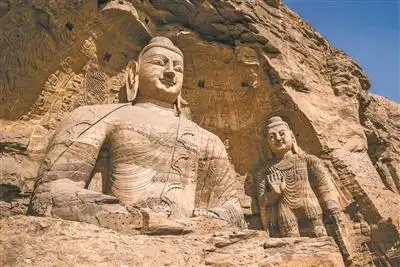
Jinling in the overall northwest, and the Pingcheng palace occupying the northwest of Pingcheng, both occupy theqian(heaven) trigram position. South of the suspected Jinling area and west of Pingcheng flows a river called the Wuzhou Creek. On its northern bank, on Mount Wuzhou, stands the grotto complex centered on the Five Caves of Tan Yao at Yungang. The Yungang Grottoes lie due west of Pingcheng and due south of the Jinling line. It is quite possible that Yungang was also a significant element in the layout of the Northern Wei imperial necropolis.
Considering that the Five Caves of Tan Yao and the large Buddha niches in the eastern section of Yungang very likely represent successive rulers of the Northern Wei, then the Yungang Grottoes, situated west of Pingcheng on the vital communication route to the old capital of Shengle, were probably a commemorative monument standing between the old capital Shengle, the new capital Pingcheng, the Jinling mausoleum, and the Deer Park. They were also a manifestation of the Northern Wei royal family’s aspiration that their departed emperors might be reborn in the Pure Land or ascend to the Tusita Heaven. On the scale of the entire metropolitan domain, they form the finishing, masterstroke of Northern Wei imperial construction.
Furthermore, the Yungang Grottoes and the Northern Wei imperial palace lie almost on a single east-west straight line. On the eastern extension of this line, crossing the Yuhe River from Parade Ground City, there is also a rammed-earth ruin that somewhat resembles a beacon tower. Scholars have identified it as the likely site of the Great Dao Altar Temple built during the reign of Emperor Taiwu (Tuoba Tao). This was an early Daoist royal structure, erected by the northern Daoist leader Kou Qianzhi for the Northern Wei emperors to “ascend the altar and receive the registers” and “receive the Mandate of Heaven.” It later became one of the key sites where successive Northern Wei emperors of the Pingcheng era performed their enthronement ceremonies.
In sum, the Pingcheng where the Northern Wei regime established its capital between 398 and 493 — with its three concentric city walls built of rammed earth, its tripartite imperial arrangement of palaces, parks, and mausoleums, and its blending of Confucian, Buddhist, and Daoist concepts — was both the dramatic overture to Datong’s role as a regional center and a model imperial capital of 1,500 years ago.By Han Kun